Everyday Sausalito Houseboat Living & Floating Homes
April 2, 2026
April 2, 2026
Dreaming of waking up on the water in Sausalito? It is easy to see the appeal. Floating homes and houseboats in Richardson Bay offer a one-of-a-kind lifestyle with big views, creative character, and a close connection to the Bay. At the same time, this is a very different living environment from a land-based home, with unique rules, infrastructure, and day-to-day considerations. If you are curious about what life is really like, this guide will walk you through the setting, the lifestyle, and the practical details so you can decide whether it fits the way you want to live. Let’s dive in.
Sausalito’s floating-home story is rooted in Richardson Bay, where residential use along the northwest Sausalito shoreline dates back to the early 1900s and expanded after World War II. According to the Bay Conservation and Development Commission’s Richardson Bay materials, this area has the largest concentration of recreational boat marinas, houseboat marinas, and long-term residential floating structures in San Francisco Bay.
Today, the community remains substantial and well established. The same BCDC materials note that the floating-home area is a legally recognized residential community just north of the Sausalito city limit, accessed off Bridgeway at Gate 5 and Gate 6. The Floating Homes Association represents more than 400 homes in five floating-home marinas, which gives you a sense of both scale and continuity.
One of the first things buyers learn is that not every home on the water is classified the same way. Under Sausalito’s municipal code, a houseboat is a floating vessel or structure used mainly for residential purposes and not mainly for active navigation, while a liveaboard is a vessel capable of active self-propelled navigation that is used as a residence.
The distinction matters because the city regulates these uses differently. Sausalito classifies a vessel occupied in its berth for more than 180 nights a year as a liveaboard, and the combined houseboat and liveaboard density in marinas or harbors is capped at 10% of total berths under the municipal code.
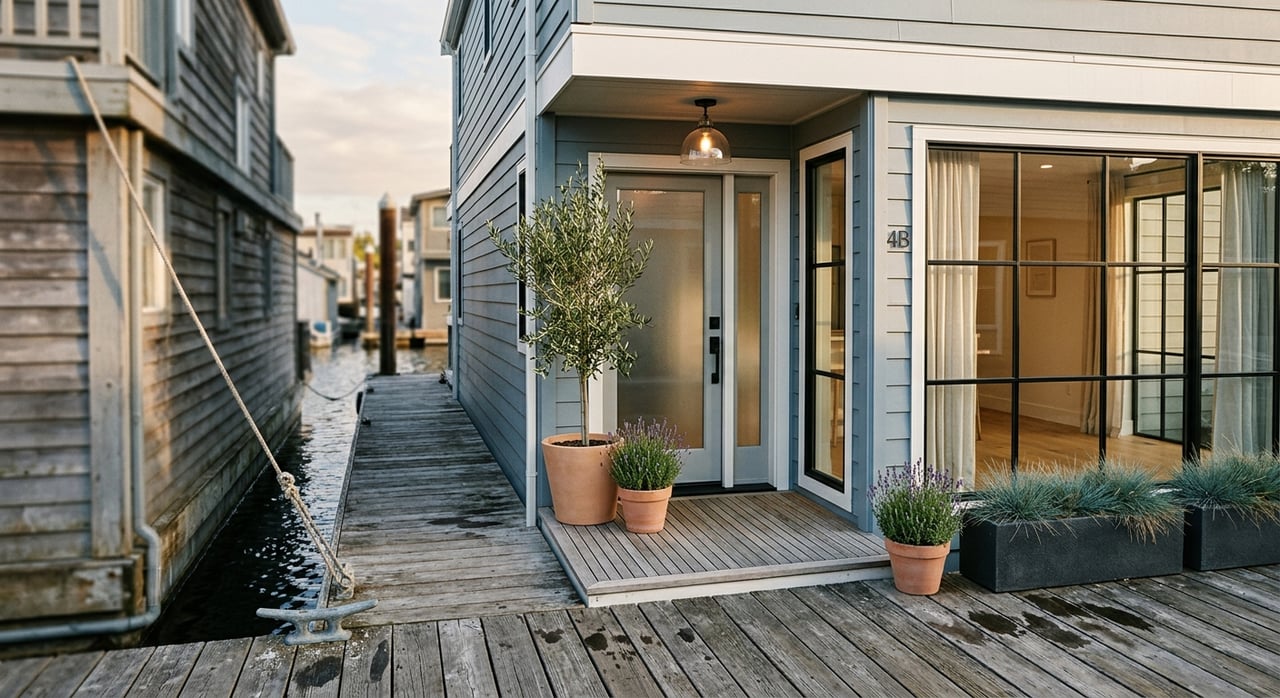
For many people, the biggest draw is not just the home itself. It is the feeling of living in a small waterfront neighborhood with a strong identity. The city’s shoreline planning materials describe the area as eclectic and hand-built, with narrow docks, colorful homes, container gardens, communal gathering spaces, and a history tied to artists, musicians, boat builders, and free thinkers.
That character still shapes day-to-day life. The City of Sausalito shoreline materials and the Floating Homes Association point to an engaged neighborhood culture with an emphasis on environmental stewardship and safety. If you value a home that feels personal, creative, and connected to the water, this setting stands apart from a conventional subdivision or condo complex.
Living here also means you are close to Sausalito’s larger waterfront network. The city’s harbors and marinas page lists marinas, yacht clubs, and boating-related businesses, including Sausalito Shipyard and Marina, which has more than 100 berths for sailboats, power boats, houseboats, and other vessels.
Access is part of the appeal. The city notes that Sausalito sits between Richardson Bay and the Marin Headlands across the Golden Gate Bridge from San Francisco, and the floating-home area is reached from Bridgeway at Gate 5 and Gate 6. The Mill Valley-Sausalito Bike Path also runs nearby, and the Turney Street Boat Ramp and Dock information notes that it is the only public, free boat ramp in southern Marin County.
If you visit, you will probably notice right away that these homes do not feel uniform. Many have an individual, handcrafted quality that reflects the area’s history. Docks, gangways, planted containers, outdoor seating areas, and ever-changing Bay light all contribute to the atmosphere.
That visual character is a major reason buyers are drawn here. You are not simply choosing square footage or a floor plan. You are choosing a living environment shaped by water, weather, marina infrastructure, and a long-standing local culture.
Floating-home living comes with more regulation than many buyers expect. Sausalito’s code treats houseboats as highly regulated waterfront structures. They must be inspected for buoyancy, stability, and structure, and they need secure water, electrical, and sewer connections along with maintained mooring gear and a gangway.
Design standards also aim to preserve the surrounding environment and shared experience. Under the city code provisions for houseboats, standards emphasize compact scale, compatible height, and protection of water views, privacy, sunlight, and shoreline access. This is helpful to know if you are comparing floating-home living with a typical single-family property, where improvements may follow a different set of expectations.
Another important reality is that supply is constrained. The city code limits houseboat and liveaboard density, which naturally affects how many opportunities come to market. In addition, Sausalito states that Marinship houseboats are a legal nonconforming use and that no new houseboats are allowed there.
For buyers, this means availability can be limited and each property may have its own specific context. Scarcity is part of what makes this niche so appealing, but it also means you benefit from careful guidance when evaluating what is actually available and how each property fits within local rules.
Parking is often one of the first practical adjustments for new residents and visitors. According to the city, parking can be difficult because many areas do not have enough spaces. That is a meaningful difference from many land-based homes in Marin, where parking is more straightforward.
The city’s resident parking information says eligible 94965 addresses can receive up to three hours of free parking in downtown lots 1 through 4 through the Resident Parking Benefit Program. Visitors use five paid downtown lots, plus a sixth lot with short-term free parking. If you are considering a floating home, it is wise to think through your own routine, visitor needs, and how often you expect to drive.
Waterfront living in Richardson Bay comes with a more marine climate than many inland Marin neighborhoods. The National Park Service’s Bay Area weather overview notes that fog can persist through summer and that microclimates vary dramatically from one neighborhood to another.
Wind is also part of the picture. The research cited by the city notes that summer afternoons regularly bring 20 to 30 knot west winds, with gale-force winds possible during winter storms. In everyday terms, you should expect cooler temperatures, more wind exposure, and a stronger relationship to the elements than you would have in many land-based homes.
Long-term shoreline conditions are another key factor. The city says flooding already affects Gate 5 Road and the North 101 on-ramp, and its sea-level rise materials note an important distinction: floating homes can rise with the tides, but shoreline access, utilities, parking areas, and docks remain fixed and vulnerable.
That means buyers should think beyond the home itself. The City of Sausalito’s sea-level rise FAQ makes clear that access points and supporting infrastructure are part of the broader waterfront equation. In other words, living here can be wonderful, but it requires a practical understanding of the shoreline environment.
Official city sources do not quantify noise in a simple way, but the location itself gives useful clues. The floating-home area sits near Bridgeway, the Gate 5 and Gate 6 corridor, US 101, and active marina uses. Because of that, some roadway and dock activity is a reasonable expectation.
For some buyers, that energy is part of the appeal of a working waterfront setting. For others, it is something to weigh carefully against the calm of being on the water. A personal visit at different times of day can be especially helpful here.
A Sausalito houseboat or floating home can be a remarkable fit if you want a home that feels deeply connected to the Bay, the weather, and a long-established waterfront community. You may love the views, the marina culture, the creative character, and the unusual sense of place that comes from living on the water.
At the same time, this is not simply a standard home with a better view. It is a different operating environment, with shared infrastructure, local regulations, parking logistics, and exposure to wind, fog, and shoreline conditions. The right fit often comes down to how much you value the lifestyle and how comfortable you are with its practical realities.
If you are considering a floating home in Sausalito or comparing it with other waterfront options in Marin, working with a local advisor can help you sort through the details with confidence. For personalized guidance on Marin waterfront living, connect with Nicole Burton for a one-on-one consultation.
Stay up to date on the latest real estate trends.
Driven by a commitment to her clients, Nicole serves them with the utmost honesty, integrity, and professionalism. Work with her today!